
Sunday, February 11, 2018
Uakari
Uakaris are unusual among primates because their tail length is substantially shorter than its body length. They have thick, dense fun on their bodies, but their heads are bald. These heads resemble skulls due to a lack of subcutaneous fat.

Sunday, January 7, 2018
Nimba otter-shrew
The Nimba otter-shrew lives exclusively in the Mount Nimba region in west Africa. It has a fleshy nose, round head, and a long tail. Most of its eyes and much of its ears are covered with dark fur. It is nocturnal, feeding on crabs, water insects, small fish, and similar prey along river banks. It digs a short nesting burrow in soft soil.
Sunday, November 19, 2017
Merriam's Pocket gopher
The Merriam's Pocket Gopher (Cratogeomis merriami) have a furry pouch of skin on each cheek, used for carrying food. Its front incisors are very long and can cope with may types of plant food. The upper parts can be yellow, brows, or black; the underparts are paler.
Friday, November 17, 2017
Large pocket gopher
The giant pocket gopher (Orthogeomys grandis) is a species of rodent in the family Geomyidae. It is found in Guatemala, Honduras, and Mexico.
Like many other pocketr gophers, the large pocket gopher dis a large burrow system using its strong-clawed forefeet. It feeds on roots, bulbs, and other underground plant parts. Mainly solitary, the large pocket gopher forms groups of 1 male and 4 female during the breeding season. Two or more young are born to easch female.
Like many other pocketr gophers, the large pocket gopher dis a large burrow system using its strong-clawed forefeet. It feeds on roots, bulbs, and other underground plant parts. Mainly solitary, the large pocket gopher forms groups of 1 male and 4 female during the breeding season. Two or more young are born to easch female.
Thursday, November 16, 2017
Giant otter shrew
The giant otter shrew (Potamogale velox) is a semiaquatic, carnivorous tenrec.
This species, which is often mistaken for a small otter, has a slender body and a long tail. This tail is used to propel itself through the water. Mainly nocturnal and solitary, the Giant otter-shrew hunts primarily on shellfish, fish, frogs, and other freshwater animals.
This species, which is often mistaken for a small otter, has a slender body and a long tail. This tail is used to propel itself through the water. Mainly nocturnal and solitary, the Giant otter-shrew hunts primarily on shellfish, fish, frogs, and other freshwater animals.
Thursday, October 12, 2017
Eastern Quoll
The eastern quoll (Dasyurus viverrinus), also known as the eastern native cat, is a medium-sized carnivorous marsupial native to Australia It is considered to be extinct on mainland Australia, but it resides in Tasmania.
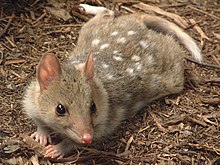
The Eastern Quoll hunts on the ground at night for mainly birds, small mammals, and lizards, though it also eats fruit, grasses, and occasionally carrion. Quolls occupy woody, shrubby habitats, as provided my mixed agriculture. Males are longer and heavier that females.
The Eastern Quoll hunts on the ground at night for mainly birds, small mammals, and lizards, though it also eats fruit, grasses, and occasionally carrion. Quolls occupy woody, shrubby habitats, as provided my mixed agriculture. Males are longer and heavier that females.
Wednesday, October 11, 2017
Quokka
The quokka, the only member of the genus Setonix, is a small macropod about the size of a domestic cat.[4] Like other marsupials in the macropod family (such as kangaroos and wallabies), the quokka is herbivorous and mainly nocturnal.

The Quokka is rare on the Australia mainland, and most of its population thrives in 2 southwest islands where many of its introduced predators are absent. After resting in the day in dense verdure, it feeds at night on grasses, leaves, and fruit.According to a study, one of the quokka's favourite foods is Guichenotia ledifolia, a small shrub species.
The Quokka is rare on the Australia mainland, and most of its population thrives in 2 southwest islands where many of its introduced predators are absent. After resting in the day in dense verdure, it feeds at night on grasses, leaves, and fruit.According to a study, one of the quokka's favourite foods is Guichenotia ledifolia, a small shrub species.
Subscribe to:
Posts (Atom)