Sunday, August 27, 2017

Pink pigeon

Columba mayeri -captive-8a.jpgThe pink pigeon (Nesoenas mayeri) is a species of pigeon in the family Columbidae endemic to Mauritius. The pink pigeons became nearly extinct in the 1990s and is still rare.

This large pigeon has a light pink body and usually brown wings. Its bright-colored bill is moderately long and has a hooked tip.


The species is currently classified as endangered.  Due to habitat destruction and introduced predators, the population had diminished to only 10 in 1991, but captive breeding and reintroduction has resulted in a population of about 450 in the wild in 2011.

Friday, August 25, 2017

Natal Midland Dwarf Chameleon


Unlike other chameleons, dwarf chameleons give birth to live young. The Natal Midland Dwarf chameleons(bradypoidon thamnobades) is a typical species, with a high casque covering its neck. Its color varies, but it is usually more colorful in the long-tailed males than in juveniles, which are often brown or gray.

Monday, August 21, 2017

Guianian lava lizard

The Guianan lava lizard (Tropidurus hispidus) is dark brown above and white below. Its flat shape allows it to hide in narrow cracks for protection against predators. The dark color of the lizard helps it to warm up quickly while basking in the sun, usually on vertical surfaces.

Friday, August 18, 2017

White-lipped pit viper

The white-lipped pit viper (Trimeresurus albolabris) is a venomous pit viper species endemic to Southeast Asia. Three subspecies are currently recognized, including the nominate subspecies described here.
Trimeresurus albolabris male.jpg
This slender green snake, easily confused with other green vipers, has a wide, rounded head with prominent heat pits. It lives in a favored hunting place waiting for prey to come within range, then drawing back its head when its ready to strike.

Thursday, August 17, 2017

Bearded barbet

The bearded barbet (Lybius dubius) is an African barbet. Barbets and toucans are a group of near passerine birds with a worldwide tropical distribution. The barbets get their name from the bristles which fringe their heavy bills.

The bearded barbet has black upperparts and red underparts, with a black breastband and whithe flanks. It feeds on fruit, mainly wild figs.

Sunday, August 13, 2017

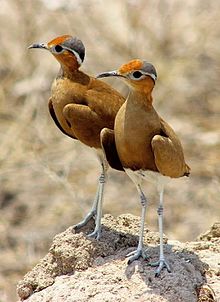
Burchell's courser

The Burchell's courser (Cursorius rufus) is a wader in the pratincole and courser family, Glareolidae.
Cursorius rufus00a.jpg

This species of wader is unique because it is the only one that can live in dry habitats. The Burchell's courser is rust brown, providing excellent camouflage in the country land, where it lives. When threatened, it stands upright to avoid detection and then runs away quickly.


Wrybill

The wrybill (Anarhynchus frontalis) is a species of plover endemic to New Zealand. It is sprecial because, unlike other birds, its beak is bent sideways.
Wrybill sitting on eggs.jpg

The beak, as mentioned earlier, is useful when feeding on beaches, allowing it to flick stones aside while searching for prey. The plumage is soft gray above and white below, which is more strongly defined in males rather than females.